
By Dr. Humberto Fernandez Miro, MD | May 2026
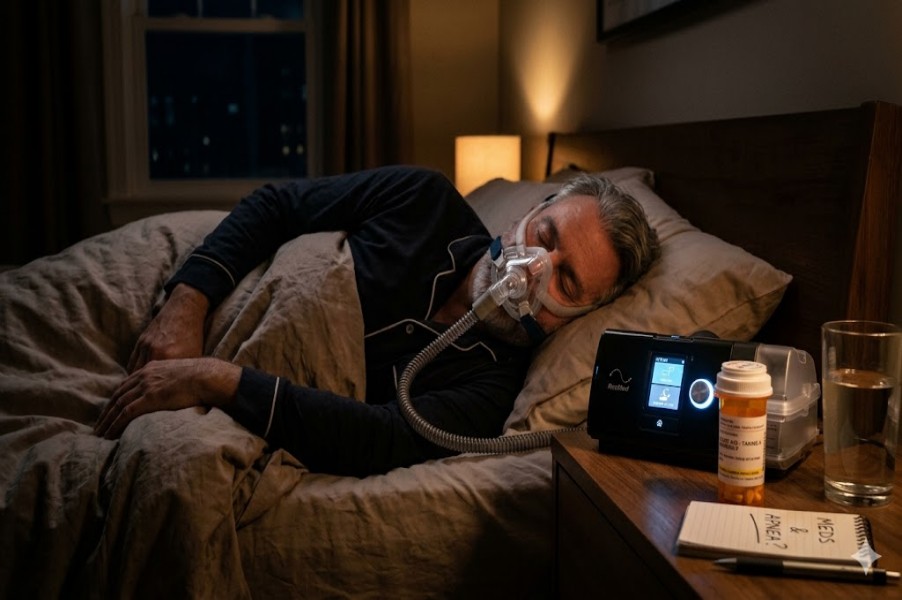
Obstructive sleep apnea and obesity are so frequently found together that clinicians sometimes treat them as a single package. Roughly 70 percent of patients with obstructive sleep apnea are overweight or obese, and the relationship runs in both directions: excess weight increases the anatomical and physiological factors that cause airway collapse during sleep, while the sleep disruption from untreated apnea worsens insulin resistance, promotes weight gain, and creates a cycle that neither condition alone is easy to break.
For years, the standard management of sleep apnea focused on CPAP therapy for the airway and generic lifestyle advice for the weight. CPAP works. It restores sleep quality, reduces cardiovascular risk, and improves daytime function. What it does not do is address the underlying adiposity driving the airway obstruction. Weight loss does. But effective, sustained weight loss was, until recently, difficult enough to achieve pharmacologically that the treatment framework had essentially accepted CPAP as a permanent intervention rather than a bridge to resolution.
That calculus is shifting. The GLP-1 medications now producing 15 to 20 percent body weight loss in clinical trials have produced sleep apnea outcomes that the field was not expecting at this magnitude, and a dedicated randomized trial has now quantified what that benefit looks like. It changes the conversation about how sleep apnea should be managed when obesity is a driver.
How Obesity Causes Sleep Apnea
The mechanical relationship between excess weight and obstructive sleep apnea is well-established. Fat deposition in the soft tissues of the upper airway, including the tongue, soft palate, and lateral pharyngeal walls, narrows the airway and increases the collapsibility that causes obstructive events during sleep. Increased abdominal and chest wall fat reduces lung volumes and decreases the traction on the upper airway that would otherwise help keep it open. The result is more frequent and more severe obstruction events, reflected in higher apnea-hypopnea index scores.
Beyond the mechanics, obesity-related metabolic dysfunction contributes to sleep apnea severity through inflammatory pathways. Elevated leptin, inflammatory cytokines, and altered respiratory control sensitivity all play roles in the phenotype of obesity-related sleep apnea that are distinct from the anatomical factors. This is partly why some patients with high BMI have mild apnea while others with similar anatomy have severe disease, and why weight loss sometimes produces improvements in apnea severity that exceed what would be predicted from the anatomical changes alone.
What the SURMOUNT-OSA Trial Found
The SURMOUNT-OSA trial was a Phase 3 randomized controlled trial specifically designed to evaluate tirzepatide in patients with obesity and moderate to severe obstructive sleep apnea. This is the first large dedicated trial of a GLP-1 agent in a sleep apnea population, and the results were striking enough to support an FDA approval of tirzepatide for adults with obesity and obstructive sleep apnea in 2024.
Participants were randomized to tirzepatide or placebo for 52 weeks. The primary outcome was change in apnea-hypopnea index, the standard measure of sleep apnea severity. In participants not using CPAP at baseline, tirzepatide produced a mean reduction in apnea-hypopnea index of approximately 25 events per hour compared to about 5 events per hour with placebo. In participants continuing CPAP throughout the trial, the reduction was approximately 29 events per hour versus 6 with placebo. Roughly half of participants in the tirzepatide group without CPAP achieved remission of sleep apnea, defined as an apnea-hypopnea index below 5, by week 52. That is not a modest improvement in a continuous measure. That is disease remission in a meaningful proportion of treated patients.
Associated outcomes improved as well. Hypoxic burden, which captures the duration and degree of oxygen desaturation during sleep, decreased significantly. Patient-reported sleep quality and daytime sleepiness improved. And the cardiometabolic improvements that characterize tirzepatide trials generally, including blood pressure reduction, triglyceride lowering, and fasting glucose improvement, were present in parallel.
What It Means for Patients on CPAP
One of the more practically significant findings from SURMOUNT-OSA is that meaningful sleep apnea improvement occurred even in patients who continued CPAP throughout the trial. This matters because it establishes that GLP-1 treatment and CPAP are not alternatives but potentially complementary, with weight loss improving the underlying disease while CPAP manages the symptomatic burden in the interim.
For patients who are CPAP-tolerant and responding well, adding a GLP-1 medication to their regimen offers the possibility of disease-level improvement over time rather than indefinite CPAP dependence. For patients who are CPAP-intolerant, which is a significant and undertreated population, effective weight loss medication may offer a meaningful alternative pathway. A patient who achieves remission of moderate sleep apnea through weight loss no longer needs CPAP for that indication.
I’ve had a few patients in my practice who were referred for CPAP evaluation and then declined it, for reasons ranging from claustrophobia to travel logistics to simply not tolerating the machine. Those patients had previously been in a clinical dead end. The emergence of effective weight loss medication with documented sleep apnea benefits changes what I can offer them.
GLP-1 Agents, Weight Loss Pills, and the Sleep Apnea Population
The sleep apnea population is a particularly strong candidate for GLP-1 treatment because obstructive sleep apnea is itself a qualifying comorbidity for most approved weight loss pills and injectable agents, including semaglutide and tirzepatide. A patient with a BMI of 27 or higher and a confirmed sleep apnea diagnosis meets criteria for pharmacotherapy under current FDA-approved indications. That is a lower BMI threshold than the standard obesity cutoff, and it captures a population that might not otherwise qualify for treatment under weight-based criteria alone.
Sleep apnea as a qualifying comorbidity also strengthens the prior authorization case for insurance coverage. Prior authorization reviewers for GLP-1 medications look for documented weight-related comorbidities, and a confirmed sleep apnea diagnosis, ideally with documented sleep study results, is one of the stronger qualifying conditions for coverage approval. Patients with obesity and sleep apnea who have been denied coverage for these medications should ensure their sleep apnea diagnosis and severity are explicitly included in any appeal documentation.
Practical Considerations for Patients
For patients with obesity and sleep apnea who are considering GLP-1 treatment, a few clinical points are worth keeping in mind. First, the sleep apnea improvement from weight loss does not happen on the same timeline as weight loss itself. The SURMOUNT-OSA data measured outcomes at 52 weeks. Patients should not expect apnea-hypopnea index improvements in the first month or two of treatment and should not discontinue CPAP prematurely based on starting a new medication. The weight loss needs to accumulate before the airway anatomy changes enough to produce measurable apnea improvement.
Second, a repeat sleep study after significant weight loss, typically 10 percent or more of body weight, is the appropriate way to evaluate whether CPAP pressure needs adjustment or whether CPAP can be discontinued entirely. Weight loss that improves sleep apnea does not always produce a linear reduction in apnea-hypopnea index. Some patients show dramatic improvement at a relatively modest weight loss; others require more. A post-treatment sleep study provides actual data rather than relying on symptom improvement alone.
Third, the sleep quality improvements from effective weight loss treatment, independent of sleep apnea changes, appear early and are often among the first subjective benefits patients notice. Reduced daytime fatigue, better sleep consolidation, and improved energy in the first two to three months of treatment are common even before significant weight loss has occurred. For patients who come in asking whether the medication is working, those functional improvements are real signals worth acknowledging.
Where This Leaves the Clinical Conversation
Sleep apnea has historically been managed as a mechanical problem requiring a mechanical solution. CPAP is effective and will remain a cornerstone of management for many patients. But for patients where obesity is clearly a driver, effective pharmacological weight loss treatment now offers a documented path to disease modification rather than indefinite symptom management.
That path is now supported by randomized trial data, an FDA approval in the specific indication, and a biologically coherent mechanism. The clinical conversation about sleep apnea that does not include a discussion of weight management pharmacotherapy options, where applicable, is leaving something meaningful off the table.
Dr. Humberto Fernandez Miro, MD, is a family medicine physician and clinical researcher with 25 years of practice in Miami, FL. He is a contributing medical writer at WeightLossPills.com.